It’s Never Too Late to Plan Your School Climate Survey

As we move into Spring 2025, some schools are wondering: Is it too late to conduct a school climate survey?

Our answer? Absolutely not!

With just a few key details from your school, we can set your school up and provide the necessary resources to launch a comprehensive school climate survey at any time of the school year.  It’s never too late to gather data—some schools even gather this data right up until the last day of school!  When you gather school climate data can also inform the data that is provided.  

With so many internal and external challenges affecting schools, now is the time to understand how students, staff, and families feel about their learning environment. A well-executed survey—no matter when it’s launched—will provide valuable insights into the experiences and perceptions of your school community. These insights serve as a foundation for meaningful school improvement, helping schools create safer, more supportive, and more effective learning spaces.

So if you’ve been wondering whether there’s still time to gather this important data, the answer is simple: Yes! Let’s get started.

Plan Ahead, No Matter the Time of Year

A school climate survey is more than just a data collection exercise—it’s an opportunity to engage your school community, understand their perspectives, and take action to create a positive learning environment. Planning ahead ensures a smooth administration process, better participation rates, and timely analysis of results.

3 Steps to Getting Ready For Your Survey

  1. Assemble Your Team

Start building a team to support the administration and analysis of the survey. This group could include school leaders, teachers, counselors, students, and even parent representatives. A strong team helps share the workload and ensures a broad perspective in planning and implementation.

  1. Set Your Data Collection Window

Identify a 2–3-week window in the spring for data collection. This allows flexibility while ensuring enough time to maximize participation. Avoid overlapping with major school events or testing periods to reduce potential conflicts.  If Spring feels too rushed, we are also happy to discuss Fall, 2025 surveys as well. 

  1. Start Communication Early

Even if all the survey details aren’t finalized yet, begin communicating now. Let your school community know that the survey is coming in Spring 2025. Building awareness before the end of the current school year helps set expectations and encourages buy-in from all stakeholders.

Learn More

Next week, we will highlight a district implementing The National School Climate Center’s school climate survey to help inform their 5-year strategic plan. 

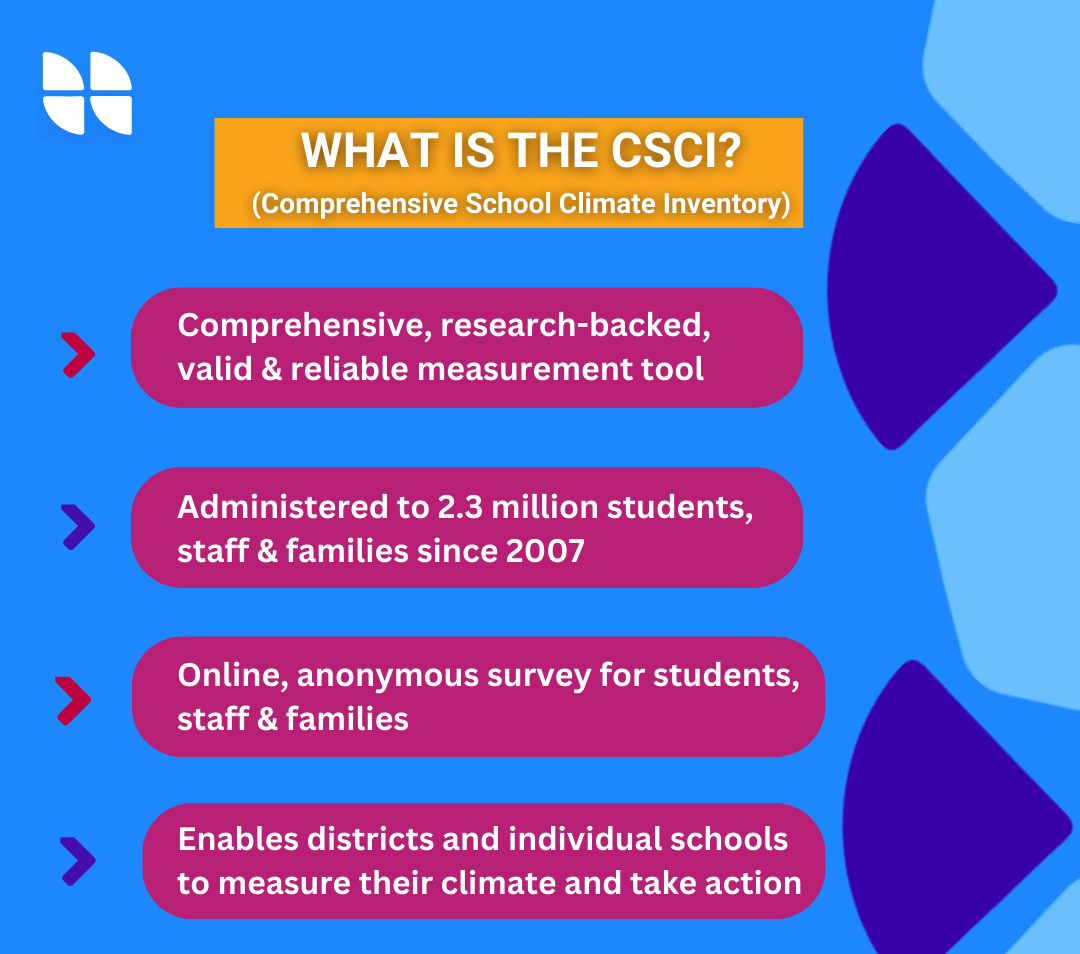
Are you ready to embark on your school climate improvement journey? Begin planning your school climate survey today by registering for a free Q&A Session or by emailing Amanda Weitzel, Director of Survey Operations at aweitzel@schoolclimate.org.


Take Your School Climate Improvement to the Next Level

Explore NSCC tools and guidance to help your school build safe, supportive, and thriving learning environments.

E Tsang, Director of Operations, National School Climate Center

E Tsang

Director of Operations

As the Director of Operations for NSCC, E Tsang helps make the finances, HR, and organizational functions of NSCC run smoothly.
Adam St. Bernard Jacobs(he/him), Co-Executive Director, National School Climate Center

Adam St. Bernard Jacobs (he/him)

Co-Executive Director

Adam is a peace educator and nonprofit leader. Adam was previously the organization’s Director of Development. Prior to joining NSCC, Adam was the co-founder and Executive Director of Kids Creative, an arts education organization in NYC. He was also a member of the team that founded a community elementary school in The Bronx. He has worked on issues of equity, anti-racism, arts education, and conflict resolution. He has written articles and led workshops in conflict resolution and the arts, giving talks and workshops at Columbia University, The Peace and Justice Studies Conference, Gettysburg College, and The University of Istanbul, among others. Adam has an undergraduate degree in International Politics, a Masters degree in Peace Education, and a Certificate in Senior Nonprofit Leadership, all from Columbia University, as well as an undergraduate degree in Rabbinic Law from The Jewish Theological Seminary of America. He was also Mr. Clown, a lead performer in the internationally acclaimed rock group for kids, The Dirty Sock Funtime Band, and was a regular on Nick Jr. and Chuck E Cheese TV. He is raising 2 fantastic children with his life partner, Tabitha.
Kori Hamilton Biagas, Director of Education, National School Climate Center

Kori Hamilton Biagas

Director of Education

Kori is an educator, connector, truth seeker, master facilitator, and the founder of Just Educators. Kori has nearly 20 years of experience in strategic planning, policy analysis and development, instruction, coaching, and technical assistance. As an Equity Specialist for the Region IV and Region IX equity assistance centers, Kori managed large-scale, racial equity driven school district transformation efforts, led district and state leaders through policy analysis, coached state leaders through school climate transformation initiatives, and provided equity-focused professional learning opportunities at all levels of education. Kori specializes in addressing and resolving inequitable policies, practices, and processes in organizations related to racial equity and social justice.
Christian Villenas, Ph.D, Co-Executive Director, National School Climate Center

Christian Villenas, Ph.D

Co-Executive Director

A sociologist by training and an applied education researcher by practice, Christian’s work examines how educational institutions shape opportunity, belonging, exclusion, and student experience. At NSCC, he helps guide the organization’s research, measurement, evaluation, partnerships, and strategic growth, with a focus on making evidence usable for schools, districts, and education partners. Before joining NSCC, Dr. Villenas held research and policy roles at GLSEN, Advocates for Children of New York, the New York City Charter School Center, the NAEP Education Statistics Services Institute, and the American Institutes for Research. Across more than two decades, his work has focused on school climate, social disparities in education, disability studies, LGBTQ student experiences, college access, education policy, program evaluation, and statistical analysis. He holds a BS from New York University, an MS from The New School, and a PhD in Sociology from Johns Hopkins University.
Amanda Weitzel, Director of School Partnerships, National School Climate Center

Amanda Weitzel

Director of School Partnerships

For over a decade at NSCC, Amanda has partnered with schools and districts across the country to support the implementation of school climate surveys and the strategic use of data to drive meaningful improvement. With a background in data analysis, customer success, and partner support, Amanda specializes in helping educators move beyond data collection to uncover actionable insights that strengthen school communities. Her work sits at the intersection of research, data, and practice, guiding school and district leaders in translating survey results into informed decisions that support student success, staff well-being, and positive learning environments. Amanda is passionate about empowering educators with the tools, knowledge, and confidence needed to create safe, supportive, and engaging schools where all students can thrive.
Samantha Elleman, Associate Director of Research, National School Climate Center

Samantha Elleman

Associate Director of Research

Samantha’s primary research topics span school climate, social inclusion, and school climate improvement. Prior to joining the National School Climate Center, Samantha worked as Assistant Teacher and Research Assistant at the Barnard Toddler Center. Her research interests include early childhood education, childhood trauma and protective factors, social-emotional education, and mental wellness in schools. Samantha holds a Bachelor of Arts in Psychology from Barnard College and a Master of Arts in Developmental Psychology from Teachers College, Columbia University.